and
- Reminder:
- Defn. means:
- , s.t. if then Frequently well use instead of
- Doesn’t really matter except:
- Typically =size of list or # nodes or …
- so it’s a whole number like 8 or 0 or 7 or…
- whereas could be any real number. Thnk of as an upper bound!
a) Defn. We say if
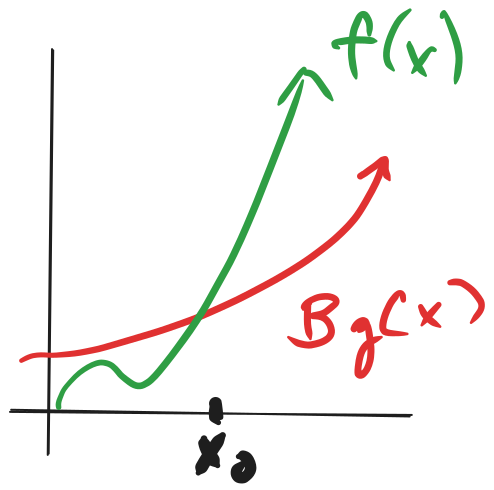
b) Def. We say if
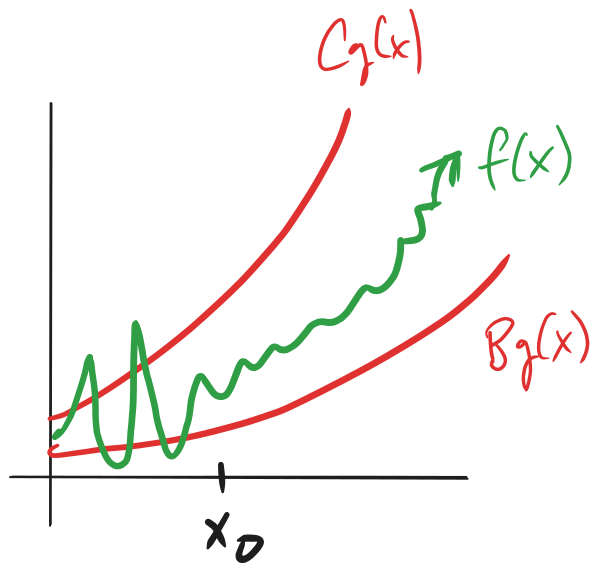
Example of proving :
(a) Prove: Want: When doing , you can chuck out the pluses. HAHA! always! Pf: Observe that , always, so defn sat. w/ and . (b) Prove: Want: Well look, when . In which case . AHA! :) Pf: Observe that if then so
So the definition is satisfied with witness and
(c) Prove:
Well: Again if so aw shucks! Issue is: we eliminated it all - could we subtract less? Well: when which is when . Now and we’ve got some left.
Pf: Observe that if , then and then So defn is sat when and .
(d) Prove:
We can throw out the since we’re proving an .
Need some multiple of but not an entire than .
when . Pf: If then so and so
So defn sat when and
(4) When possible give instead of . Why? Well: but too, and too… Whereas but . If you can give both an upper and lower bound, that’s better.
(5) Intuition: Whenever dealing with an expression, it’s always of the “largest” term. ex. ex.
Largest goes in order